
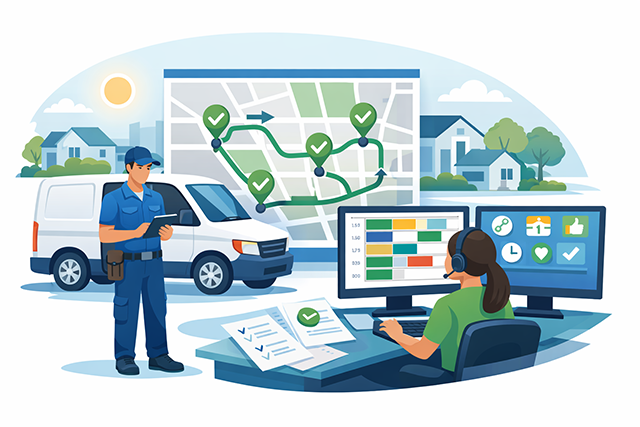
Every field service leader wants more completed jobs, better customer coverage, and healthier margins. The problem is how organizations try to get there.
They demand more jobs per day, tighten schedules, push technicians to work faster, and add stops to already-full routes. On paper, this seems productive. In reality, it causes missed windows, rushed work, more reschedules, more windshield time, and a team that always feels behind.
A better way to increase daily job capacity is to focus on better operations, not more pressure.
Don’t turn the day into a pressure cooker. Remove the friction that reduces capacity.
More jobs per day start with capacity, not pressure
When teams talk about productivity, they often picture technician effort. But technician effort is only one part of the equation. The bigger constraint is usually the operation around them.
A technician can only complete as many quality jobs as the day actually allows. If the schedule is unrealistic, the job was assigned to the wrong person, appointments are stacked without regard for travel, or the inputs are messy from the start, the day is already broken before the first truck leaves.
“More jobs per day” means “waste less,” not “work harder.”
In practice, capacity grows when you reduce the operational drag that eats into the day:
- Less backtracking
- Fewer avoidable reassignments
- More realistic job durations
- Better technician-to-job matching
- Smarter routing and sequencing
- Fewer surprises that force the whole day off course
When these improve, teams complete more work without feeling overwhelmed.
The hidden capacity leaks that make the day feel impossible
If your technicians are busy all day but the operation still struggles to fit in more work, the problem is often not a lack of effort. It is leakage.
Here are three of the biggest capacity leaks.
1. Backtracking that eats up the schedule
Backtracking is one of the most expensive forms of hidden waste in field service. A technician finishes a job, drives across town, then doubles back later because the sequence of stops was inefficient or the next assignment was not planned with geography in mind.
This is not just a routing issue. It is a capacity issue.
Every unnecessary mile means lost availability. The technician spends more time driving and less time doing billable or customer-facing work. By day’s end, routing inefficiencies can cost a full job slot.
Over a week or a month, that lost capacity becomes substantial.
2. Misassignment that creates avoidable friction
A job goes to the nearest technician, not always the right one. Or, a dispatcher lacks a clear view of skills, certifications, needed parts, or job complexity. The result: a technician arrives underprepared, takes too long, or the work must be reassigned.
Misassignment creates a chain reaction:
- Delays at the current stop
- Late arrivals at the next stop
- Increased reschedules
- More calls into dispatch
- Lower first-time fix performance
- Rising frustration on both sides of the operation
This clearly shows how poor input causes burnout. The technician is not struggling with their tasks. The problem is that the system forces them to deal with preventable mistakes.
3. Unrealistic schedules that break the day by noon
Some schedules look efficient only in theory.
They assume every job takes the estimated time, with no traffic, surprises, overruns, customer delays, missing information, or hidden complexity in a simple work order.
But field service is unpredictable. Unrealistic schedules make days unravel fast. One long job delays the next. One late arrival causes a reschedule. One reschedule lowers customer satisfaction and adds work tomorrow.
That is how teams end up feeling chronically overloaded even when headcount has not changed. The problem is not always a capacity shortage. Often, it is a failure in capacity planning.
Why pressure creates burnout but not real productivity
Pushing harder brings a short-term bump but long-term damage.
When teams are squeezed, quality drops. Safety risks rise. Communication shrinks. Corners are cut. Turnover climbs. Top technicians see chaos, not competence.
That is not a sustainable productivity strategy.
Burnout comes from repeated friction, not just long hours.
- Being sent to the wrong jobs
- Running behind because the schedule was never realistic
- Spending too much time driving
- Getting blamed for delays caused upstream
- Feeling like the day is happening to you instead of being set up for success
To get more jobs done without burnout, focus on operational design rather than pressure.
The operational fixes that create more daily capacity
The good news is that many of the biggest capacity problems are fixable. They do not require superhuman effort. They require better discipline in how work gets planned and executed.
Fix the inputs first
Bad scheduling decisions often begin with bad job inputs.
If the work order lacks clear duration, priority, required skills, geography, customer constraints, or job details, dispatch is making decisions with incomplete information. That forces guesswork into the schedule.
Better inputs create better assignments and smoother days.
Start by tightening the data that feeds scheduling:
- Standardize job types and expected duration ranges.
- Document required skills or certifications.
- Capture customer time constraints accurately.
- Flag priority and urgency clearly
- Include location details that reduce confusion in the field.
- Note dependencies such as parts, follow-up work, or special equipment
You do not need perfect data to improve planning. You need cleaner, more consistent data than you have today.
Build planning discipline into the day
Planning discipline turns intent into results.
Many operations rely on last-minute manual decisions. Even top dispatchers can’t plan well if they’re stuck in reaction mode.
Planning discipline means:
- Scheduling based on real capacity, not hopeful capacity
- Sequencing jobs with geography in mind
- Protecting the day from unnecessary disruption
- Using consistent rules for priority, duration, and assignment
- Reviewing schedule quality, not just schedule fullness
A full board doesn’t mean the day is efficient. Overloaded boards hide poor planning.
The better question is this: Does today’s plan give technicians a fair chance to complete their work on time, without excessive driving or constant reshuffling?
If the plan isn’t realistic, adding jobs only makes things worse.
Reduce variance wherever you can
Variance is a major, underestimated cause of inefficiency.
Some variance is unavoidable. Jobs differ. Customers differ. Traffic differs. Real life happens.
But a surprising amount of variance comes from preventable inconsistency:
- Work orders are created differently by different people
- Duration estimates based on habit instead of history
- Different dispatch standards across shifts or teams
- Incomplete intake processes
- Unclear rules for prioritization and routing
High variance makes schedules fragile. One disruption can ruin the day.
Reducing variance makes operations predictable. Predictability creates room for more jobs.
Scale through stability, not by adding uncertainty. Build days that work in real conditions.
What leaders should measure if they want more jobs per day
To grow capacity without burnout, measure where the day breaks down.
Three metrics are especially useful.
1. On-time starts
On-time starts tell you whether the day is launching as planned.
If jobs start late, look for upstream issues:
- Bad routing
- Overloaded schedules
- Inaccurate duration estimates
- Poor dispatch sequencing
- High travel friction
On-time starts are important because they are an early signal. When the first few jobs go late, the rest of the day usually gets worse. Improving on-time starts often boosts the entire schedule.
2. Reschedules
Reschedules clearly show the operation exceeds its capacity.
Not every reschedule is avoidable, but recurring ones indicate a planning problem, not a technician issue.
Track:
- Total reschedules
- Same-day reschedules
- Reason for reschedule
- Whether reschedules cluster by team, geography, job type, or dispatcher
- Whether reschedules follow long travel sequences or overloaded days
This separates true demand spikes from operational flaws.
3. Variance
Variance is the difference between plan and reality.
It shows up in many places:
- Estimated versus actual job duration
- Planned versus actual travel time
- Scheduled versus actual start time
- Assigned versus completed jobs per day
High variance makes capacity hard to trust. Low variance makes planning more reliable.
This is why variance should not be treated as background noise. It should be treated as a core management signal. The more you understand your sources of variance, the more confidently you can fit work into the day without tipping the team into exhaustion.
A better message for the field: support, not squeeze
The way leaders talk about productivity matters.
If technicians hear “we need more jobs per day,” they may assume that leadership is asking them to rush. If what leadership really means is “we are going to remove the friction that wastes your time,” that creates a completely different response.
One message creates defensiveness. The other creates buy-in.
This is where good operations and good leadership meet. Productivity gains stick when the field sees that the goal is to make the day work better, not just feel harder.
More jobs per day are the result of better systems
The best service organizations do not create capacity by running people harder. They create capacity by running the operation smarter.
- They reduce backtracking.
- They improve assignment quality.
- They build realistic schedules.
- They tighten inputs.
- They reduce unnecessary variance.
- They measure the signals that show where the day is slipping.
That is how you fit more jobs into the day without burning out the team. More jobs per day should be the outcome of a healthier system, not a heavier burden.