Paper timesheets used to feel simple: a clipboard, a pen, a quick signature at the end of the day.
But for most modern field teams, that “simplicity” hides a lot of costly noise: missing hours, misread handwriting, delayed submissions, and the inevitable, expensive payroll corrections.
Industries such as field services, utilities, and delivery services have a demonstrated need to reclaim hours, eliminate waste, and improve payroll accuracy. Shifting from paper to automated time tracking helps them achieve these goals while also keeping up with technology.
Let’s unpack why digital time tracking pays for itself faster than you might think, and what automated accuracy really looks like in the field.
The real cost of paper timesheets
It’s easy to underestimate how much money old-school time tracking eats up.
According to an EY survey, the average payroll error costs $291 per employee, per year. For a 50-person team, that’s nearly $15,000 every year to fix preventable mistakes.
Where does that loss come from?
- Human error: illegible writing, wrong job codes, rounding up or down.
- Delayed reporting: supervisors wait until the end of the week to collect and enter data.
- Duplicate data entry: moving handwritten hours into payroll systems.
- Buddy punching: one employee clocking in for another.
Even with honest, hardworking people, a manual system is prone to errors. Every extra step between the worker and the payroll file multiplies the risk.
How automated time tracking works and why it’s different
When people hear “automated time tracking,” they often think it just means clocking in from a phone instead of on paper.
In reality, today’s systems do far more than record start and stop times. They simplify the entire process for both workers and managers.
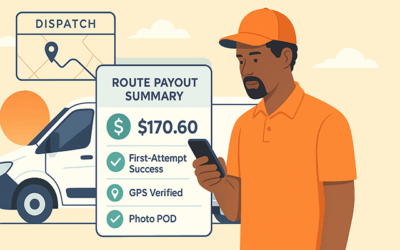
Automated time tracking connects your crew’s location, schedule, and job data in real time, so hours are logged accurately without manual entry or daily paperwork.
Here’s what that might look like in practice:
- Automatic check-ins: When a crew member arrives at a job site, the system recognizes their location and records the start of the shift. No tapping or typing required.
- Smart reminders: If someone forgets to clock out, the system flags the missing entry and sends a quick notification.
- Job-based tracking: Hours are automatically linked to the right customer, project, or cost code for easier billing and reporting.
- Payroll integration: Verified hours flow directly into payroll, eliminating the need to re-enter data or chase down approvals.
Instead of relying on memory, guesswork, or stacks of paper, automated systems capture what’s happening in the field as it happens.
The result is simple yet powerful: increased accuracy, reduced administrative work, and a process your team can actually trust.
The immediate ROI: Time, accuracy, and trust
For most field service and construction teams, margins are tight and time is everything. That’s why the return on investment from automated time tracking shows up almost immediately.
Time saved
Supervisors reclaim hours every week by removing the need to collect, decipher, and enter handwritten timesheets. Workers spend less time trying to remember when they started and more time getting the job done.
Accuracy improved
Automated check-ins and digital timestamps reduce errors by as much as 80 percent, according to multiple payroll studies. Every clock-in and clock-out is verified by location and schedule, leaving no room for missed punches or rounding mistakes.
Trust built
When everyone can see their hours in real time, payroll stops feeling like a guessing game. Transparency builds confidence across the team. Managers trust the data, and employees trust that they’re being paid for every minute they work.
By replacing manual reporting with automatic, verified data, you gain a system that works quietly in the background, protecting both productivity and payroll accuracy.
Hidden benefits you don’t see on a spreadsheet
- Compliance confidence. Accurate records are your first line of defense in wage-and-hour audits. With digital logs, you can prove compliance in minutes, not days.
- Better forecasting. Historical time data helps you estimate labor costs for future projects with real-world precision. Automation can even flag under- or over-utilized crews before overruns occur.
- Faster billing. When time data flows seamlessly from the field to the back office, invoicing happens faster, and cash flow improves.
- Reduced burnout. Automated scheduling and time alerts can help identify overworked team members and distribute labor more evenly across shifts.
Overcoming the “we’re not ready for automation” objection
Many small or mid-sized businesses hesitate to adopt automated time tracking because it sounds complex or expensive.
But implementation doesn’t have to be intimidating.
Start with a simple rollout plan:
- Pick one pilot crew for testing. Ideally, choose a group already comfortable with mobile apps.
- Run a side-by-side comparison for 30 days: paper vs. digital.
- Measure the outcomes: time saved on admin, number of corrections, and employee satisfaction.
- Expand gradually once you have established trust.
Most teams discover within the first pay cycle that the software “pays for itself.” That’s not an exaggeration. It’s math.
Case example: The 10-minute fix that saved five hours
One Archlogix customer, a regional landscaping company, transitioned from handwritten sheets to SmartWorks over a single weekend. Within the first week, managers reported saving five hours on payroll preparation and catching two time-entry errors that would have cost hundreds.
When the owner saw the system’s job reports by site and crew, he said, “That’s not tech. That’s breathing room.”
The human side of automation
It’s worth remembering: automation isn’t about replacing people. It’s about giving them the tools to do their best work without the noise.
- When workers can focus on their jobs rather than paperwork, productivity naturally rises.
- When managers trust the data, decisions get faster.
- When payroll runs smoothly without errors, everyone gets paid on time.
That’s the real payoff of automated accuracy: not just better data, but better days.
“That’s not tech. That’s breathing room.”
What automated accuracy looks like in the field
For years, time tracking relied on memory and manual effort: clock-ins scribbled on paper, job codes written after the fact, and hours retyped into payroll systems.
Automation changes that completely.
With automated time tracking, clock-ins happen automatically as workers arrive on site. Job codes and tasks are assigned based on schedules or locations, eliminating the need to provide additional details. Supervisors receive automatic alerts for any unusual activity, such as a missing clock-out or an unexpected overtime flag, so they can correct issues before they reach payroll. Once everything is verified, hours transfer directly into your payroll system with no duplicate entry and minimal delay.
The difference is simple but dramatic: what used to be a manual, error-prone process now runs quietly and accurately in the background, keeping everyone aligned and on time.
Automation replaces uncertainty with precision. Documentation and correct coding occur for every shift and job, and every paycheck reflects the work done. That’s what accuracy looks like when the process finally works for you, not against you.
Measuring success: KPIs for time tracking ROI
To prove that your investment in automation is paying off, focus on a few key performance indicators during your first three months.
Start with payroll processing time. Many organizations report reducing it by 30 to 70 percent after adopting automated time tracking, according to industry research. Verified clock-ins and location-based validation can also result in up to 80 percent fewer payroll errors. This results in improvements in both accuracy and trust in the process.
You should also see measurable improvements in labor cost variance, as managers finally have reliable, real-time visibility into where hours are going and why. Submission rates climb, too. Digital systems make it nearly impossible to forget or lose a timesheet, so on-time submissions often rise above 95 percent.
Perhaps the most telling metric is employee satisfaction with payroll accuracy. When workers see that their time is recorded accurately and their paychecks match reality, trust in the system increases. That’s a cultural as well as financial win.
When your back-office efficiency, field visibility, and team confidence all improve at once, it’s clear the technology is doing what it should: simplifying your operations and strengthening your business.
Key takeaway
Automated time tracking doesn’t just eliminate errors, but also friction.
From faster payrolls to better planning, it’s an investment that pays dividends in time, accuracy, and trust. And for field-based teams, that means more than saved dollars. It means smoother days and happier crews.
Frequently Asked Questions
Q: How does automated time tracking prevent time fraud or “buddy punching”?
These solutions use GPS verification and unique device authentication to ensure the person clocking in is actually on-site.
Q: What’s the average setup time for an automated time tracking tool?
Most systems, including Archlogix’s SmartWorks, can be deployed in under a week with minimal training required.
Ready to stop chasing paper?
See how Archlogix automates time tracking, payroll accuracy, and crew reporting all in one place. Book a demo now!