Independent drivers give delivery and field service businesses something priceless: elasticity. When volume spikes or routes shift, a strong contractor bench turns a scramble into a typical day. The catch is pay. If your rate card ignores what actually makes a route hard, you will feel it in late arrivals, churn, and customer complaints. If it matches real effort to real money, you get the opposite: drivers who stay, show up, and treat your brand like it is theirs.
This guide walks through how to design pay that earns trust and performance. It compares standard models, explains the costs drivers actually face, and shows a realistic weekly reconciliation so nobody has to guess how the math works. It ends with a simple cadence for reviewing rates each quarter, before small problems grow into big ones.
Practical guidance only, not legal advice. Confirm classification, insurance, and pay practices with counsel and your broker.
Why does the pay structure drive performance?
Pay is not just a number. It is your operating model in shorthand. If you pay only by distance, drivers will gravitate toward long, simple lanes and avoid dense routes with stairs, access codes, and elevators. Suppose you pay per stop but ignore dwell time. In that case, routes through high-security buildings or apartment complexes become unpopular, and you start to see missed windows. When pay and work are out of sync, behavior follows the money.
A good plan does three things. First, it aligns earnings with the work that actually happens, not an idealized version. Second, it gives predictability. Drivers want to know what a route is worth before they tap “accept,” and dispatch wants to know what it will cost before they release. Third, it rewards outcomes you care about: on-time arrivals, first-attempt success, and a good experience at the door. When drivers can see those targets and hit them, you get fewer reattempts and faster cash flow.
How the main pay models feel in the real world
You will hear lots of terminology, but there are only a few basic shapes.
Per stop treats each delivery as a unit. On dense urban routes with similar complexity, it is delightfully simple. Drivers look at a stop count and know what they earn. The weakness appears when a handful of stops take five times as long as the rest. If you like per stop, plan to add a small modifier for those outliers.
Per route pays a flat rate for a defined bundle of work within a service window. It is easy to quote and reconcile. It shines in markets where density and dwell are stable, and it gets wobbly when either starts drifting. You can stabilize it by reviewing recent route data and adjusting the base before frustration sets in.
Per hour equivalent is not a time clock. It is a way to translate the usual route time into a fair route or stop rate, especially for white-glove or technical jobs with setup, haul-away, or testing. It can work well if you anchor it with proof, such as GPS breadcrumbs and photo POD, so neither side feels exposed.
Per mile is the original courier logic. For airport runs, line-haul between hubs, or rural shuttles, distance tells most of the story. For residential or mixed commercial routes, it captures only part of the time spent at the door and requires add-ons to account for the rest.
Most teams end up with a hybrid. A base rate covers typical distance and density. Simple adders handle excess miles, large stop counts, or complexity. It feels fair because it flexes where real work flexes, and it stays predictable because drivers can estimate earnings at a glance.
The costs drivers actually carry
If your card does not recognize a real cost, drivers will. Distance and drive time matter, but so do the things that slow a route down in ways your map cannot see. Apartments and secure buildings add minutes at the door. Heavy or awkward items change how a driver moves through a site and whether a second person is needed. Returns and reattempts consume an outsized share of time. Peak windows compress all of it into narrow blocks of the day, when traffic and parking are worst.
A fair card accounts for those realities. You do not need 40 line items. You need the right ones. For most businesses, that means a base rate tied to location type, a light ladder for large stop counts, a distance add-on when routes go beyond a cap, and three or four small modifiers that cover the most frequent sources of extra effort. The goal is not perfect precision. It is a shared understanding of what “normal” looks like and how to handle the days that are not.
Incentives that move the needle
Incentives are the fine brush. They do not replace pay. They highlight what matters most this week. Two rules keep them effective. The driver must control the outcome, and the payout must be fast. First-attempt delivery is the classic example. When drivers earn a small bonus for hitting a weekly target, they work a little harder to make a final phone call or to capture a perfect photo that satisfies the building staff. Photo POD quality works the same way. A short checklist, a visible score, and a small weekly payout elevate consistency without heavy policing.
Other incentives deserve restraint. “Customer ratings” can be helpful if there are enough of them. A strong driver should not miss a bonus because only three people rated their week. “Peak window” premiums are helpful during the season and should be modest; otherwise, you distort routing. The safest pattern is a few small weekly bonuses paid like clockwork. The signal to the network is clear: do the basics at a high level, get the bump.
Guardrails that make fairness provable
Trust grows when both sides can prove what happened. Publish your guardrails in the driver portal and hold yourself to the same standard. Routes should have GPS breadcrumbs for the entire shift. Each stop should have either a photo that meets a simple framing rule or a signature when required. Fraud flags should be rare, specific, and appealable. If you audit a handful of stops each week and close disputes within three business days, your message is not “we do not trust you.” It is “we close the loop.”
Useful guardrails to publish
- Geofenced arrival required for a stop to count
- Photo standards in one image with three example shots
- Reasons a stop may be rejected and how to fix it
- A short, dated list of fraud flags and what triggers a review
- A simple dispute form with a 72-hour response window
Each item removes uncertainty. Uncertainty is expensive.
A sample hybrid rate card in plain English
Imagine three zones. Urban routes under 40 total miles pay a base of $70. Suburban routes under 70 miles pay $90. Rural routes under 120 miles pay $120. Within that base, up to 50 stops are included. If a suburban route climbs to 65 stops, the extra 15 earn a dollar and ten cents each on top of the base. Apartments or secure buildings add sixty cents per affected stop. Signature stops add thirty cents. Heavy items that require a hand truck add seventy-five cents. If a lift gate is needed, it costs $10 to use. If the route runs long in distance, each zone has a small per-mile add-on over its cap.
Returns and reattempts are paid but modestly, since they represent extra time without new revenue. A simple version pays two dollars for a reattempt the next day, three fifty for a same-day return to the hub because a site denied access, and six dollars to take a package back to a merchant, plus mileage if it is off route.
Incentives sit on top. A driver who finishes the week at 97 percent first-attempt success earns twenty-five dollars. If their photo score, measured by a quick quality check, averages 95 percent or better, another ten dollars lands in the payout. Ratings above 4.8 with at least twenty rated stops pay another ten. None of these is huge. Together, they steer behavior and create a sense of progress.
What weekly reconciliation looks like
Here is a real-world week told in numbers. A suburban route runs 68 miles and covers 65 stops. Twelve stops are apartments. Eight require signatures. Ten involve heavier items. One lift-gate use. One reattempt. First-attempt success lands at 98 percent. The photo score is 96 percent. Average rating is 4.7.
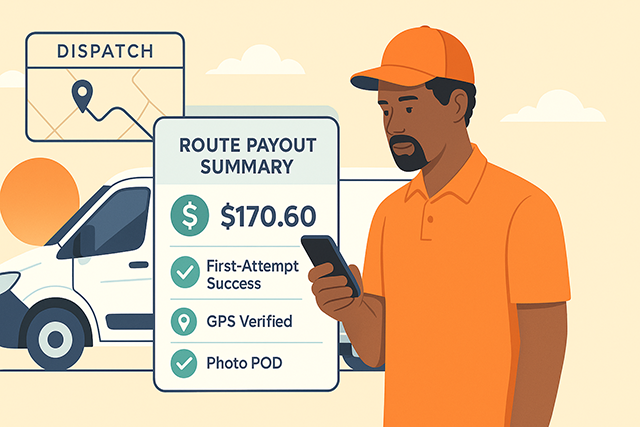
Start with the base. Suburban under 70 miles pays $90. The distance add-on is zero because the route stayed under the cap. Fifteen stops sit above the included 50, so those add $16.50. Apartment modifiers add $7.20. Signatures add $2.40. Heavy items add $7.50. The single lift-gate adds $10. The reattempt adds $2. Incentives add $25 for first-attempt success and $10 for photo quality. Put it together, and the week pays $170.60.
What matters more than the total is the transparency. Each line can be checked. Drivers learn the shape of a good day, and dispatch sees the cost of the hard ones before they assign them.
How to review and adjust each quarter
Even good plans drift. Volume shifts. A new building with strict access rules joins the mix. Peak season teaches lessons. A 90-day cadence keeps the rate card grounded in reality.
Start with the data you already have. Stops per mile by zone will tell you whether density has changed. Dwell time by building type will show whether your modifiers are sized right. Reattempt and return rates will point to where a small process or pay tweak could save hours. Compare what you projected to what actually happened. If the average route time in a zone rose by more than 10 percent, the base likely needs a slight lift, or you need to tighten how you build routes.
Next, tune incentives. If everyone earns a bonus every week, either the network has leveled up and the bonus has done its job, or the bar is too low. If almost no one hits a target, the message is discouraging, and the bar is too high. Gather driver feedback with a one-minute survey and confirm it with two ride-alongs per market. Communicate any changes at least two weeks before they take effect and include a “before and after” example so nobody is surprised.
Finally, pilot every change in one market for two weeks. The small trial protects trust and lets you fix edge cases without a network-wide reset.
A short implementation checklist
- Map your current routes by zone and typical density.
- Time the five building types or job patterns that slow you down.
- Draft a one-page rate card with a clean base, a light stop ladder, a distance add-on, and three or four clear modifiers.
- Build a payout PDF that shows the math line by line.
- Publish guardrails and a simple dispute process.
- Pilot in one market, adjust, then roll out with office hours.
Frequently Asked Questions
How do I choose between per stop and per route?
If your work is dense and similar from stop to stop, per stop stays fair and simple. If your lanes are consistent by distance and time, per route is easier to plan. If neither is true, a hybrid gives you predictability without ignoring complexity.
Should I pay for reattempts?
Yes, at a lower rate than the original stop. It covers time and fuel without rewarding missed windows. Make the rule public so nobody is negotiating at the dock door.
How often should I change rates?
Quarterly is common. Review the numbers, test changes in one market, and communicate two weeks ahead with examples.
Do incentives actually work?
They do when the driver controls the outcome and the payout arrives fast. First-attempt success and photo quality are reliable choices.
What proof should I require for payouts?
Keep it simple and consistent: route-long GPS breadcrumbs, a geofenced arrival, and a photo or signature that meets published standards.