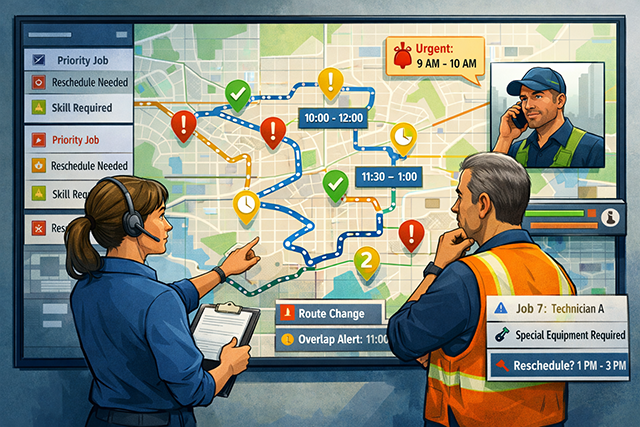
There is a reason more fleet, delivery, and field service companies are talking about building their own routing tools.
On the surface, it makes sense. Internal teams know the business, territories, service windows, technician skills, customers needing special handling, and dispatcher habits that don’t fit off-the-shelf software. Add vibe coding and AI-assisted development, and the idea is even more tempting. If you can quickly prototype a working app, why not build your own routing engine?
Because drawing routes is not the hard part.
The hard part is building a routing tool that helps the day hold together in real operations, not just on a screen at 7:00 a.m., but after delays start stacking up, priorities change, someone calls out, a job runs long, and dispatch has to decide whether the rest of the day can still be saved.
That is where the conversation needs to shift. Route optimization is not mainly a software story. It’s an operations story. A company can likely build a tool that produces routes. But can it reduce windshield time, cut backtracking, increase capacity, reduce dispatch rework, and make service delivery more predictable? That is the standard that matters.
Why is the idea so appealing?
The interest in building internally usually comes from a real frustration.
Many operators feel that generic routing products do not accurately reflect how their businesses actually operate. A route may look efficient in theory, but ignore the things dispatch has to juggle every day, such as skill requirements, customer priorities, promised time windows, territory boundaries, job-duration realities, asset constraints, and the simple fact that some schedules are risky before the first truck ever leaves the yard.
That frustration is legitimate.
A custom tool promises something off-the-shelf software often struggles to deliver: a better fit for how your operation really runs. If your business has unusual rules or exceptions, building internally can feel like the only way to avoid forcing teams into someone else’s logic.
There is also a speed argument. With AI-assisted development, teams can stand up prototypes faster than ever. Once a manager describes the scheduling problem, an engineer can turn it into an interface and create a working concept. That kind of speed creates momentum. It makes the project feel more practical than theoretical.
And, in fairness, sometimes an internal tool can solve a narrow, valuable problem. Maybe the goal is just to improve schedules and routes within a specific, unchanging territory. Or maybe dispatch just needs a stronger starting plan. In these cases, an internal build may deliver real wins.
That is the good news.
The problem is that teams often mistake a promising prototype for a dependable operational system.
The biggest mistake: thinking routing is mostly a map problem
Routing is often oversimplified.
In theory, a route is just marking stops on a map, some travel/speed/time logic, a few service windows, and computing the shortest or fastest path. But that is not what dispatch lives with.
Dispatch manages moving targets. Job durations are estimates. Priorities shift. Conditions change. Customers cancel. Urgent jobs are added. Drivers and technicians vary. Balanced routes fall apart after one long stop. Efficient plans on paper create rework in the field.
That is why better routing is ultimately about enforcing scheduling discipline. Routing itself is not the goal. The real objective is a workday with less wasted motion, fewer disruptions, and better predictability.
A routing tool that creates drive paths without considering operational realities can actually make things worse. Schedules might look tight and efficient, but fall apart within a few hours. Then, dispatch is back to manual cleanup, midday reshuffling, and apologizing to customers for delays.
If the plan is too simple and optimistic from the start, the software isn’t solving the problem. It’s enabling it.
Looking optimized on a map is not enough. A good route should help the day run better.
Where an internal build can genuinely make sense
This is not an argument against building internally in every case.
There are real scenarios where a custom routing tool is worth considering.
First, some businesses face struggles that commercial tools aren’t built to handle. The work behind the routes may involve specific certifications for some tasks, union rules, recurring territory assignments, or equipment-labor combinations that do not fit standard scheduling logic. Forcing such operations into generic software can introduce inefficiencies of its own.
Second, routing may be at the core of the business’s success. If field capacity, number of stops, or schedule reliability have a massive impact on profit margins and customer experience, there is a reasonable case for owning more of the logic. That can be especially true if route quality directly affects revenue, labor costs, and service consistency.
Third, an internal tool works when the scope is disciplined. Solve a clear problem rather than replicate a full platform. Improving daily sequencing, surfacing conflicts earlier, or helping dispatch compare options are manageable objectives. “Build our own enterprise-grade optimization stack” is rarely true.
The key is that the company has to know what it is actually trying to own.
Not “routing” in the abstract. A specific operational outcome.
Where companies get burned
The risks tend to show up in four places.
1. They underestimate the long tail of exceptions
The first version often works on the clean cases.
Then real operations show up. A technician has the right skill but is in the wrong zone. A high-priority customer has a narrow delivery window. A stop needs a specific vehicle. A route looks efficient, but leaves no room for urgent late-day work. A dispatcher knows from experience that one location always runs long on Thursdays, but the system does not.
As exceptions grow, so does manual override.
If a tool cannot reflect the judgment that experienced dispatchers use to keep the day from unraveling, it becomes one more thing they have to work around. And once dispatch stops trusting the recommendation, adoption fades fast. The real competitor is often not another vendor. It is manual planning, tribal knowledge, and “the way we have always done it.”
2. They confuse a prototype with a product
A prototype proves that something can be built. A product has proven that it can be trusted.
That means staying on top of performance, reliability, permissions, testing, integration, change management, training, auditability, maintenance, and ongoing refinement. Someone needs to own the system after launch. For a routing tool, the company must continually update route and job duration data, skill definitions, and territory logic.
3. They ignore input quality
No routing logic can fix bad data. (This is also true when using third-party solutions.)
If job durations are inaccurate, skill requirements are incomplete, priorities are vague, territories are inconsistent, or service windows are unrealistic, the resulting route optimization will be weak no matter how impressive the software appears. Good routing depends on accurate data and sound logic. Bad data and practices can’t be fixed with software, no matter who develops it.
This is also why internal builds often disappoint leadership. The company expects the tool to solve operational messiness without ever addressing the problems that create it. Weak planning discipline will always undermine route quality before optimization ever begins.
4. They focus on technology instead of operational waste
This is the most common storytelling mistake and often the most expensive strategic mistake, too.
A company gets excited about algorithms, automation, and custom logic, losing focus on business value. The goal is not to own sophisticated software, but rather to reduce wasted drive time, minimize backtracking, make schedules realistic, and free up time without disrupting operations.
If the build does not reduce dispatch rework or improve day-to-day predictability, it fails the true test. The result is a tech project, not an operational gain.
What operators should ask before they build
Before investing in an internal routing tool, a company should be able to answer a few uncomfortable questions.
- Where is the wasted time really coming from? Is it mainly poor route sequencing, or is it bad duration data, loose intake standards, weak territory design, and constant last-minute changes?
- What decisions do dispatchers make that could realistically be automated by a tool?
- What metrics measure success? These metrics should reflect improvements to operations, not just software activity.
- Who will own the system in the long run? Who maintains logic, handles exceptions, updates rules, and earns trust from teams?
If those answers are fuzzy, the business is probably not ready to build.
A smarter path for many companies
For many operations, the best move is not building a routing product from scratch.
Combine proven routing tools with stronger planning discipline to deliver real operational results. The goal should always be sustained, measurable business improvements through better routing practices.
That may mean adopting software that lets dispatch account for duration, skills, and priority before scheduling all the jobs for the day. It may mean using tools that reduce manual cleanup and make plans more consistent and repeatable. It may also mean improving the quality of scheduling data before expecting route quality to improve.
Predictability is what field operations companies are really buying when they invest in route optimization. They want fewer surprises, less wasted motion, and fewer days that collapse. They want dispatch to spend less time firefighting. They want field teams spending less time driving and more time doing the work that actually moves the business forward.
The real standard
Building your own routing tool is not inherently a bad idea. But it is often pursued for the wrong reason.
If the motivation is, “We can build this faster now,” that is not enough.
If the motivation is, “We want better operational control, less wasted time, more realistic schedules, and less rework for dispatch,” then the conversation is starting in the right place.
Looking optimized on a map is not enough. A good route should help the day run better. It should reduce windshield time and cut backtracking. It should make room for more profitable work without creating more chaos.
That is what route optimization should be judged on, whether you build it yourself or buy it from someone else. That is why companies should be careful before turning routing into a coding project. The real work is not producing routes. The real work is building an operation that can trust them.
Too much time lost between jobs? Start with a better plan.
If your team is dealing with too much windshield time, fragile schedules, and constant route cleanup, the problem usually is not just the route. It is the planning logic behind the day. Archlogix helps field teams build smarter daily schedules, reduce wasted drive time, and create more capacity without adding chaos.