Running a small service business often means wearing many hats. You’re scheduling jobs, managing teams, talking to customers, handling payroll, and making sure the day doesn’t fall apart when something goes wrong. With so many moving pieces, it’s easy to overlook one of the most costly parts of the operation: time spent on the road.
Every extra mile driven translates into higher fuel bills, increased vehicle wear and tear, and lost time that teams could have spent serving another customer. For a small business, those inefficiencies add up quickly and sometimes silently, until you notice margins getting tighter and customer satisfaction slipping.
That’s where route optimization comes in. By planning smarter routes for your crews, you reduce wasted time and fuel, and open the door to smoother days, happier employees, and healthier profits.
Why route planning matters more than you think
It’s tempting to think of route planning as something you can do on the fly. You write up the day’s jobs, maybe sort them by zip code, and send crews out with the addresses. But in practice, that usually leads to unnecessary driving. Crews double back to neighborhoods they already passed. A technician might end up across town in the morning, only to be sent right back later in the day.
The result: more fuel consumption, more hours wasted in the truck, and fewer job completions. For customers, it means waiting longer than they should. For your team, it means added stress and less productivity.
Route optimization takes the guesswork out of scheduling (no more hoping the order of stops on a route makes sense). Instead, you design routes that reduce backtracking, balance workloads, and keep everyone moving in the right direction.
The hidden costs of inefficient routes
It’s easy to underestimate the cost of inefficient routes to a small business. The losses come in several forms:
Fuel costs
Fuel prices are unpredictable, but they’ve been on an upward trend. A few extra miles per day may not seem like much, but across multiple vehicles, those costs quickly add up.
Employee time
Every hour a crew spends driving is an hour not spent serving customers. Even reclaiming one extra job per week per crew can significantly boost revenue.
Vehicle wear and tear
The more you drive, the more maintenance is required. Tires, brakes, and oil changes all occur more frequently when your routes aren’t efficient. And every extra mile shortens the overall lifespan of your vehicles.
Customer satisfaction
Delayed arrivals or rescheduled jobs frustrate customers. Efficient routes allow for more accurate arrival windows and faster service, which leads to better reviews and more referrals.
For small businesses operating on thin margins, cutting waste in these areas is one of the fastest ways to improve profitability.
What route optimization looks like in practice
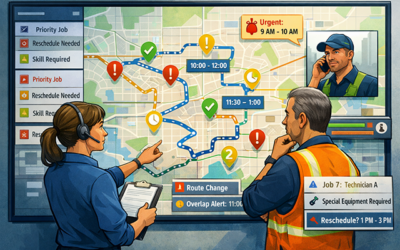
Route optimization isn’t about adding complicated logistics software to your business. For small service teams, it means using tools that factor in job addresses, drive times, and crew availability to produce a daily plan that actually works.
A well-optimized route ensures that:
- Crews move logically from one job to the next.
- Travel time is minimized, even in the face of traffic or unexpected delays.
- Workloads are balanced, so no single crew is overburdened.
- Everyone sees the day’s plan right from the start, and supervisors can react quickly and accurately when issues pop up during the day, requiring adjustments.
Think of it as better scheduling, not more management. The aim is to make the day smoother, not heavier with process.
Real-world example: A landscaping crew
Let’s imagine a three-person landscaping crew servicing residential yards in a mid-sized city. Without route optimization, the day might look like this:
- 8:00 a.m.: An apartment complex on the east side of town
- 10:00 a.m.: A long-time customer with a large HOA-ruled lawn on the west side
- 1:00 p.m.: Back to the east side for three houses in the same neighborhood.
- 3:00 p.m.: Another west-side job
By the end of the day, they’ve driven 50 miles zigzagging across town.
Now, picture the same day with route optimization. Managers can group jobs by geography and prioritize them by estimated completion time. As a result, the crew is scheduled on the east side until lunch, then moves west for the afternoon. The total driving distance drops to 30 miles. At $3.50 a gallon, that’s a fuel savings of $7–10 per day per truck. Over a month, that’s several hundred dollars saved on fuel alone. Add in the time reclaimed for one or two extra jobs per week, and the revenue impact becomes significant.
How Archlogix makes route planning simple
We built Archlogix with small service businesses in mind. Many route planning systems are designed for enterprise logistics teams and come loaded with features that small crews will never use. Archlogix takes a different approach: practical tools, no bloat.
With Archlogix, you can:
- Assign jobs to crews based on location, not just order of arrival
- See daily routes laid out clearly, with estimated travel times
- Update routes quickly when a job changes or traffic slows things down
- Give employees a simple, mobile-friendly view of their schedule and route
The goal isn’t to track every movement. It’s to provide a plan that makes sense, reduces wasted time, and keeps everyone moving efficiently.
The ripple effects of smarter routes
When you save time and fuel, the benefits extend beyond just cost savings.
Employees are less stressed.
Spending less time in traffic means more time completing jobs and a smoother workday.
Customers get better service.
Shorter travel times lead to more accurate arrival windows and faster turnaround.
Businesses can scale more easily.
With extra capacity, you can add jobs without needing to increase staff.
Vehicles last longer.
Lower mileage per day translates into less wear and tear, fewer breakdowns, and longer lifespans.
For a small business, even minor efficiency improvements can mean the difference between breaking even and thriving.
Start Small and See the Results
Route optimization doesn’t have to be overwhelming. Start by reordering jobs to reduce backtracking. Then use tools like Archlogix to automate the process and continually improve day after day.
The savings will compound: a few dollars per day in fuel savings, an extra job completed each week, and even longer-lasting vehicles.
Conclusion
For small service businesses, efficiency isn’t a luxury. It’s survival. Route optimization is one of the most straightforward ways to reduce costs and increase capacity without adding more vehicles, employees, or overhead.
Archlogix makes it possible with simple, grounded tools that help you plan smarter and deliver faster. No bloat. Just tools that work.
Want to see how Archlogix can simplify your routes? Book a free demo today.